How to run a raffle draw people can trust (and prove it was fair)
Nobody should have to take your word that a raffle was fair. Here's what makes a draw trustworthy, the mistakes that start the "it was rigged" talk, and how a published proof lets anyone check the winners.
Oct 26, 2026 · 4 min read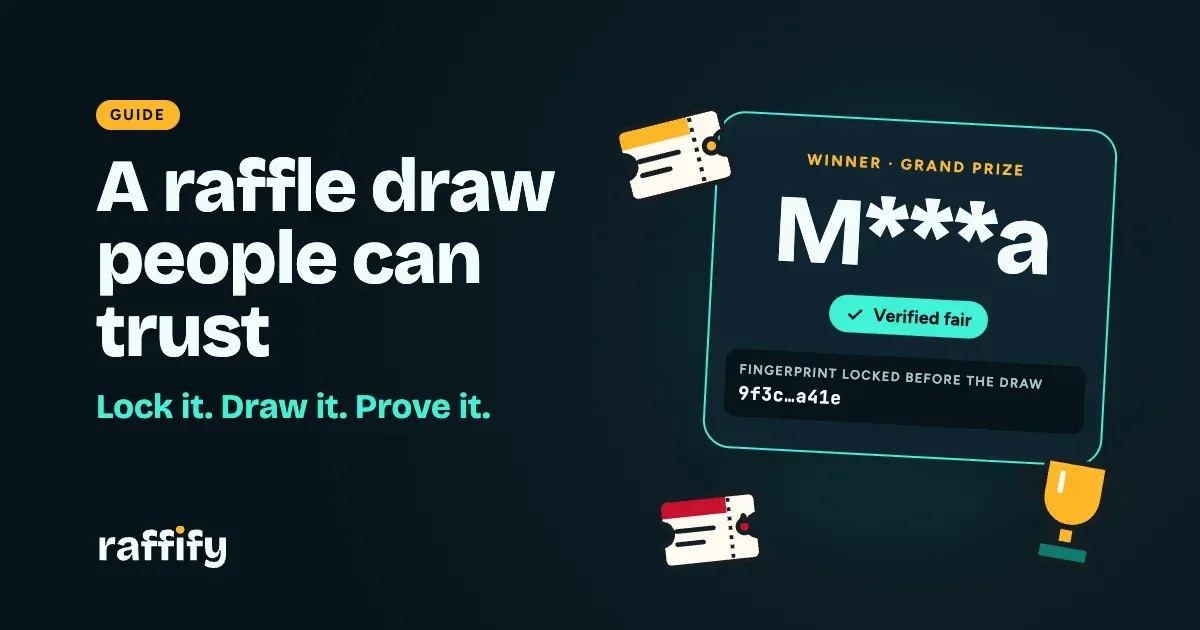
Every raffle host has heard it at least once: "Was that really random?"
It's rarely a real accusation. It's just what people think when the winner is the host's cousin, or when the names were drawn from a bowl no one could see into. A raffle only works if people believe it was fair, so a fair raffle draw is as much about showing fairness as about being fair.
This guide covers what makes a draw trustworthy, the mistakes that cause trouble, and how to let your participants check the result themselves.
What a fair raffle draw needs
Three things, in this order:
- Everyone who entered is in the draw, once per entry. Nobody is left out and nobody is added late.
- The winner is picked by chance, and you can't influence it. Not you, not a helper, not a lucky bounce of a wheel.
- People can see how it was done. If the only evidence is "trust me", the draw is fair but nobody can tell.
Most "rigged" rumors start from number 3, not from anything that really went wrong.
Five mistakes that start the rumors
1. Drawing from a closed container. A box on a table with a hand reaching in looks fair until someone asks who folded the papers. Open containers and a clear list help, but people at the back still see nothing.
2. Adding or removing entries after the fact. Letting a late friend in "just this once" is the most common way a fair draw becomes an unfair one. Close entries at a stated time, and keep that time.
3. Re-drawing without saying why. Sometimes a re-draw is right: the winner left, or they're not eligible. But a re-draw that nobody explains looks like you're hunting for a better winner. Say the reason out loud and write it down.
4. Letting the host or a relative win with no check. Hosts and their family can win, but then the proof matters even more. Decide the rule before the draw (for example, "host and helpers don't enter") and announce it.
5. Picking with a wheel or a "stop" button. A spinning wheel is fun, but if a person decides when it stops, a person decides the winner. The winner should be picked by chance, and the wheel should only show it.
How Raffify keeps the draw fair
Here's the one sentence to tell your crowd: nobody can change who wins, and anyone can check the winners afterwards.
Once entries close, the list is frozen. Raffify picks the winners by chance, and the animation on the screen is just the show. After the draw, the raffle's Fairness page lets anyone check the winners themselves.
What this means for you: you can't choose winners, and you can't re-run the draw until you like the result. Re-draws (for example, a winner who isn't present) are recorded with the reason.
Read the plain-language version in our guide, How the fairness proof works.
A checklist for a draw people trust
Before the draw:
- Say how people enter and when entries close, in writing.
- Decide who can win (for example, whether the host and helpers can).
- Decide what happens if a winner isn't there: a wait time, then a re-draw.
- Tell people the draw will be live, and whether it's in the room, online or both.
During the draw:
- Draw live, on a screen everyone can see, rather than announcing results afterwards.
- Say the winner's name or masked entry out loud, and give the prize a moment.
- If you re-draw, say why before you do it.
After the draw:
- Share the Fairness page link in your group chat or post, so people who missed the live draw can check.
- Keep winner details private. Winners are shown masked by default, so a post doesn't expose anyone's email or phone number.
- Thank everyone for joining, including the people who didn't win.
Fair raffle draw FAQ
Can the host still win their own raffle? Nothing stops it, but it's better to decide the rule up front. Many hosts keep themselves and helpers out. If you do enter, the proof lets everyone check the result.
What if the winner isn't there? Agree on a wait time before the draw, then re-draw the prize. The re-draw and its reason are recorded, so nobody can say you picked a different winner on a whim.
Do participants need to understand the fairness proof? No. Most people will just watch the draw. The proof is there for the one person who asks, and for anyone who wants to check later.
Do participants pay to enter? No. Entering a raffle on Raffify is always free.
Is the draw fair whichever way people enter? Yes. Printed tickets, codes, invites and sign-up links all go into the same draw. Our guide to choosing an entry method covers how to pick one.
Ready to run your own? Create your free host account, set up your raffle, and share the Fairness page after the draw. Planning a party raffle? Start with our Christmas party raffle guide.
Share this post
Run your next raffle here
Free to join for everyone, with a live draw anyone can check.